
Hash Traditions
HASH TRADITIONS
Hash Traditions can be frequently used songs or chants that one can expect to hear in very specific instances or for very specific accusations, but can also be anything that somebody can expect to hear or see frequently at the hash. Whenever possible I’ve included an explanation of when the traditions are invoked and why it is done, but for many of these traditions I simply do not know. It is important to remember that these are not rules, as there are no rules in hashing, and traditions can be and frequently are broken.
ON-OUT
Tradition: When meeting for a hash two times are generally given - the first time represents the approximate time that hashers will begin assembling. In Chicago this is generally done at a bar, a hashers house, or just about anywhere - it is important to keep in mind where this is taking place, as you can always show up earlier at a bar, but showing up earlier at somebody's house might result in there not being anyone to let you in. The second time represents the "On-Out" time, or the approximate time that hashers will leave in order to run trail - though this is a published time that the pack will leave to run trail it is by no means a definite time. Normal On-Out time is 30 minutes after the published meeting time.
Hashes that run in the afternoon tend to be a lot more lenient about the On-Out time, as are warm weather hashes. Showing up late by no means excludes one from running trail, as it is more than likely a racist will catch up to the slower pack members - showing up late to trail will often result in a down-down and the shame of having to run al by your lonesome.
TRAIL
Tradition: Since one of the tenants of hashing is going out and working up a good sweat, a trail is necessary for hash members in run in order to justify their beer drinking. Beforehand a hasher usually will sign up to hare anywhere from a few weeks to a few months in advance, select a start location, and begin planning a trail. Trails are generally denoted base on two sets of factors: when they are laid and where they end.
Trails where the pack is running trail after the hare has laid the trail are referred to as "dead lays" - much like your ex, the trail just lays there and takes whatever you give it. Dead lay trails are usually laid a few hours in advance of trail and are the most common type of trail found in Chicago. Trails where the pack and the hare are out on trail at the same time are considered "Live" trails - usually a hare is given a short head start before the pack leaves and if the hare is caught on trail, whoever caught the hare is given a head start and continues trail. In the event that no hare can be found, a "pick-up hash" may be held where the hare is picked from among the attending hashers and is forced to lay a live trail.
The second way to differentiate between trails is by where they end - trails that begin and end in the same place are referred to as A-to-A trails while trails that begin and end in different locations are referred to as A-to-B trails. A-to-A trails are the most common type found in Chicago, as trails usually begin and end at the same bar, but it is not uncommon for trails to start at a bar and end at a particular hasher's house.
Along with trail, hares are also responsible for including a beer stop on trail. Any location will generally do, as long as it doesn't result in public intoxication charges being filed against the hash. In exchange for running the beer stop, the hares are not required to pay hash cash at any hashes they lay. Since the point of the hash is to drink beer first and get exercise later, hares are encouraged to lay their trails so that all members of the hash get to the beer stop at about the same time regardless of their running ability – besides, there’s nothing more annoying that getting to a beer stop to discover that all of the front running bastards have already finished all of the beers. Extra care should also be paid to making sure that you’re trail is not too easy to short cut, as discovering that everyone has missed a large portion of trail and made it to the beer stop before you is no fun either.
CHALK TALK
Tradition: Before embarking on trail it is important for hashers to know what they are looking for to know where trail is taking them - with this in mind "Chalk Talk" is called before the pack leaves on trail and it is the hare's duty to familiarize the pack with the marks that they will encounter (on a live trail usually a member of the mismanagement will handle chalk talk). Usually trail is laid in either flour (often colored with carpenter’s chalk) or in chalk (dry wall works best) and what are referred to as “standard Chicago marks” is used.
Since marks change from hash to hash, however, it is important that all visitors be paid special attention at chalk talk, as well as any virgins (since they obviously have no idea what they're looking for). Any non-standard Chicago marks that are used should especially pointed out to the pack, as using them could result in the entire pack getting lost and missing the beer stop.
STANDARD CHICAGO MARKS
TRAIL MARK:
The most basic of all marks, follow the direction that the arrow points – when the arrow turns, you turn, etc. Keep in mind that it is not uncommon for Trail Marks to be hidden (especially after splits and checks) in order to keep the pack honest. Also, though it is encouraged to do so, hares often forget to lay their Trail Marks under lights when hashing at night, so a flashlight may be required to find trail.
Variations: When trail is marked in flour, the Trail Mark is often simply a blob of flour – a curved line is used to indicate when the trail turns.
SPLIT:
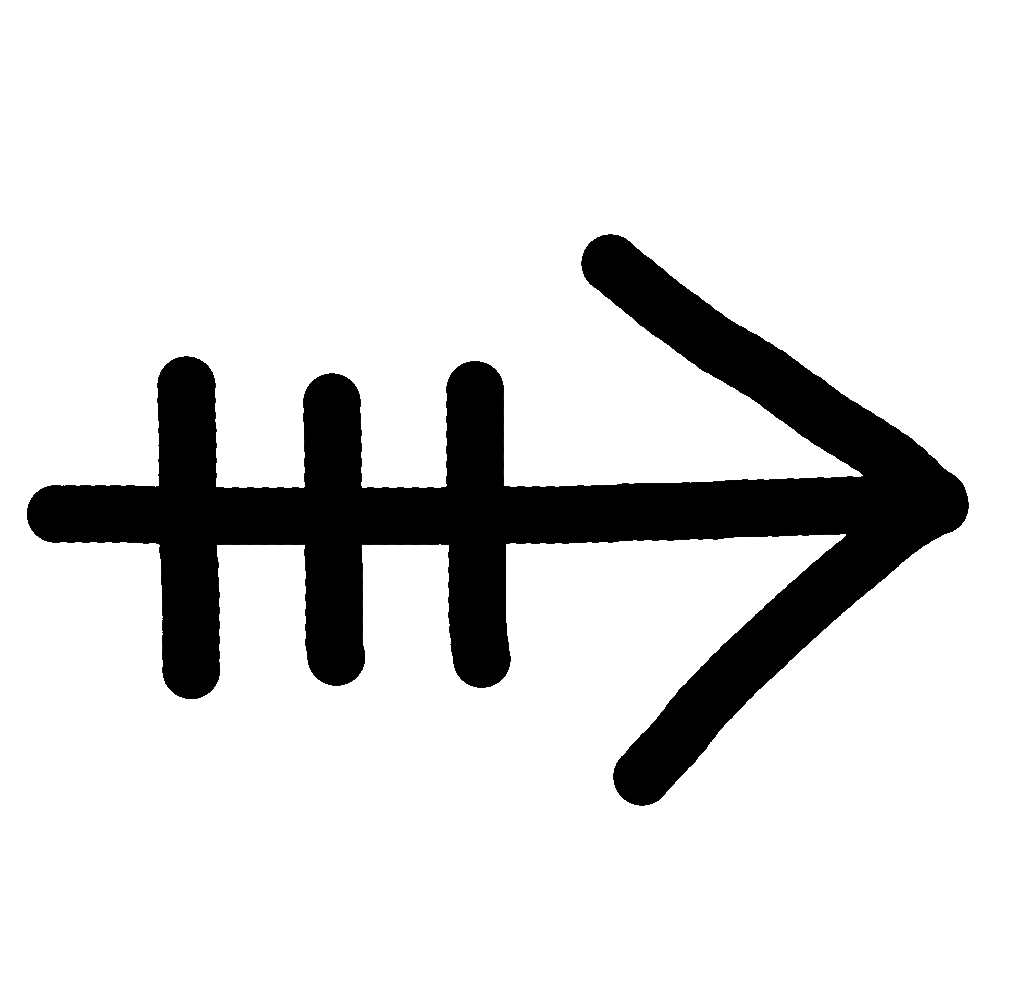
Indicates that the trail can head in one of any of the directions that an arrow is pointing. After a Split only one Trail Mark is required to indicate which way true trail goes.
Variations: A split can point any number of ways, though two and three-way splits are by far the most common.
Another common variation is the “Turkey-Eagle” split, where each arrow is designated with either a “T” or an “E” – this denotes that the hardcore racists should follow the “Eagle” trail while the slower hashers should take the “Turkey” trail, thereby allowing both groups to get to the Beer Stop at roughly the same time.
Purpose: Splits can be used to slow down the faster runners slightly, but since only one mark is needed after a Split to be on True Trail they do not slow down the faster runners as much as Checks.
CHECK:
Indicates that trail can go in any direction other than whence it came. After a check three marks are required to find true trail, if only one or two marks are found after a Check, go back to the check and try another direction. Any Splits that are found after Checks are generally considered to count as only one mark.
Variations: Sometimes marked with only one circle with an X, or simply with an X – these do not change the meaning of the mark.
Purpose: Checks allow the slower runners to catch up while the faster runners go out and attempt to solve
BACK CHECK:
Indicated with a fishhook, a Back Check indicates that you should turn around and head back in the direction whence you came. Often this means the next mark was hidden in a spot you couldn’t see when facing the original direction. This is a dynamic mark, as it gives anyone who turns around the chance to be the first one to find true trail.
Variations: Sometimes a number is placed under the arrow, indicating that the hasher should return that many marks before looking for trail. This is a more static mark, as it requires the pack to wait for the front runners to count off the number of marks before true trail can be found.
Purpose: Brings the pack back together as well as gives the slower runners a chance to lead the pack.
FALSE:
Affectionately known as a “You’ve Been Fucked” a False is used after a split or a check to indicate that the pack has been duped and that true trail doesn’t go in this direction – upon seeing a False, you should head back to the previous check and try again. A False is sometimes referred to as “The Hares Fucked Up,” usually it is called this by short-cutting bastards who will continue through a false in an attempt to find true trail after it.
SWEPT MARK:
If the pack comes to a split or a check that has already been completed by another hashing, they will often see one of two marks. A Trail Mark with three lines through it indicates the direction of true trail while a Trail Mark with an X through it indicates the direction of a False. Splits can also be swept by placing an arrow immediately following the split to indicate the direction of true trail.
BEER NEAR & BEER:
The two most important marks, the first indicates that the Beer Stop is nearby (the exact distance can vary, though usually the beer will be found in less than half of a mile) and the second that the Beer Stop has been found.
OTHER MARKS:
There are any number of additional marks that can be used when marking trail, but these are the most commonly found marks in Chicago – though it is not out of line to introduce new marks to the hash, hares should remember that any late arrivers as well as anyone not paying attention during chalk talk won’t necessarily know what those marks mean and new marks could result in hashers getting lost on trail. As per most hashing traditions, marks are subject to change from hash to hash, so be sure to pay extra close attention during chalk talk when visiting another hash.
SHORTCUTTING
Tradition: Since hashing is partially a path-finding exercise, some hasher take great delight in running trail exactly as it has been laid while others do not. It should be noted, however that “Shortcutting is not only allowed, but encouraged.” This is not to say that shortcutting won’t result in being accused for a down-down, but since the reward for finishing first is the same as the punishment for finishing last there really is no point to shortcutting just to get to the beer stop before everybody else. Then again, if the hare is stupid and makes an easily shortcut-able trail they should likewise be punished with extra down-downs.
R U?
Tradition: While out on trail there are three worldwide calls that every hasher needs to know, as they will allow you to know which way true trail goes. These three calls are:
R U?
Calling out “R U?” is done to inquire whether or not that particular person is on true trail or not. Used frequently when one encounters a split or a check, and less frequently if one sees a hasher running in an opposite direction than trail is marked. This is also used as a way to distinguish a hasher from a non-hasher at non-sanctioned events.
On-On
Calling out “On-On” is traditionally done whenever a hasher encounters a mark or has found true trail. While out on trail hashers can sometimes substitute whistles and other noise-making devices for calling out “On-On” – using a whistle is especially helpful in urban areas that have lots of ambient noise, making yelling less effective.
Variation: After a check hasher usually call out “On-___” where the number of marks they’ve discovered after the check is placed in the blank.
Checking
A common response to “R U?” that indicates that the particular hasher has not yet discovered the direction that true trail goes – follow after any hasher who responds with this at your own risk.
CIRCLE
Tradition: Upon the conclusion of trail (either by returning to the starting bar or by reaching their destination), hashers are generally given a few minutes break in order to pour themselves a beer, use the restroom, or anything else that they might need to finish before “Circle” is called by the attending RA. The RA (short for “Religious Advisor”) then commences with the calling of accusations, a calling out of hashers for either ridicule or for praise. When a hasher has been accused, they then come into the middle of the circle and before the entire hash, the accusation is stated, and a song is sung. Upon conclusion of the song, the hasher must then finish their beer. If a hasher does not want to finish their beer (for whatever reason), they are permitted to pour the remainder of their beer on their head. It should be noted that there is no defense for accusations, and anyone who is called out for a down-down must come into the circle unless the RA states otherwise.
In Chicago, the RA is usually the one in charge of calling out other hashers for accusations, but after an indeterminate amount of time, the RA may open the circle and allow other hashers to accuse each other. Accusations are chosen via the “Pint of Lager” method, where anyone who has something to say places their beverage over their head and are selected by the RA.
Circle started as a way for the pack to get back at the hares for a particularly shitty trail (or to congratulate them for a particularly memorable one,) over time accusations have become more and more plentiful and varied. Depending on who is RAing, Circle can vary from being only a handful of accusations and lasting a few minutes or including many accusations and lasting for hours. Generally speaking, however, the circle will last until either the hash cash has been exhausted or the hash has grown weary or bored.
HASH CASH
Tradition: Simply put, if you don’t pay Hash Cash you don’t drink with the Hash. Specifically, when attending a hash, every hasher pays a pre-determined amount (in Chicago this currently ranges from $5-$8 for regular events, special events are of course more) and the money for all hashers is pooled. Hashers are then allowed to drink as much or as little as they wish until all of the hash cash has been spent (hares are encouraged to notify a bar beforehand and try to negotiate a deal so that the hash cash goes further.) When all of the hash cash has been spent, a hat is usually passed around and any hashers that wish to continue drinking may throw in money for more communal beer.
Since the Hash Cash tends to go further when cheap beer is purchased, some hashers choose to instead drink a higher quality beer, they do paying out of their own pocket. Choosing to go this route will usually result in a down-down for beer snobbery and is the origin of the “Heineken” song.
INTERNATIONAL HASH HYMN
Melody – Swing Low, Sweet Chariot
CHORUS:
Swing low, sweet chariot,
Coming forth to carry me home,
Swing low, sweet chariot,
Coming forth to carry me home.
I looked over Jordan, and what did I see,
Coming forth the carry me home,
A band of angels coming after me,
Coming for to carry me home.
If you get there before I do,
Coming forth to carry me home,
Tell all my friends that I’m coming too,
Coming forth to carry me home.
Tradition: At the closing of the circle the RA will state: “Hats off, pots on the ground! Time for some Hash Religion!” This signals that the circle has come to a close and that the International Hash Hymn will be sung.
Variations: Variations of the chorus are sung after the song is completed:
- EZ on the Ass Version - everything after the first line is replaced with “Fuck this is bullshit, I’m going home!”
- Hum It!
- Men’s Version - sung in a deep voice with all the words after “coming” replaced with snoring
- Munchkin Version - sung as if you’re in the Wizard of Oz
- Scooby-Doo Version - sung in a Scooby-Doo voice
- Tongues out, double time!
- Tourettes - after the first line member break into random curses
- Women’s Version - sung in a high voice with the word “coming” repeated over and over again
SUSPENDING CIRCLE
Every now and again the RA may choose to suspend circle rather than close the circle entirely – often this is done if circumstances beyond the hashes’ control occur (a change in weather, the arrival of food, the sudden arrival of strippers, etc.) before everyone has had a chance to accuse one another of violating hash traditions. This was a particularly popular tactic of Calvin Klein to ensure that even though he’s no longer RA at CH3, he can still reconvene one of the several hundred circles he suspended and never re-opened.
HEAD CHANT
Melody - Chant
Head! Who said head?
I’ll take some of that,
And I did, and it was good,
And there was much rejoicing!
And then we fucked.
We fucked for hours,
Uprooting trees, shrubs, & flowers,
Scaring small children and woodland animals,
We fucked like Vikings,
With horns upon ours heads!
Head! Who said head?
I'll take some of that!
We don’t want women with good taste,
We want women who taste good!
Tradition: Use of the word “head” is strictly forbidden at the hash unless somebody’s name includes it – it is therefore okay to call out Too Much Head for an accusation, but not to exclaim that you’re actually getting too much head (and since that’s not possible, you’d never say it anyway). It is also permissible to use “head” as part of a compound noun (such as “headgear” or “headcase”). If you do use the word “head” (either on purpose or accidentally), you can expect to hear this chant shouted as a response.
Variants: Sometimes the harriettes will, after "We want women who taste good" will say, "A good man is hard to find, a hard man is good to find!”
Notes: I generally let this go once per circle, just so that everyone gets it out of their system – like most things it is funny once, but rarely funny twice. Often hashers will try to “trick” the RA into saying “head” during circle, especially when explaining down-downs to Virgins, but since the RA never makes a mistake they don’t know what they’re doing.
ZICKE ZACKE!
Melody - Chant
Zicke zacke!
Zicke zacke!
Hoi hoi hoi!
Tradition: Whenever a hasher repeats an accusation, an announcement, or a song this chant is used as a way of shaming them. This is actually an old German toast, but I’ve no idea how it got turned into a way to shame another hasher.
Optional Verses: Generally that first part is chanted twice before additional verses are added in until whoever repeated something had finished their beer. There are any number of variations on these, so don’t be shy if you come up with a good one.
Helicopter,
Whirl, Whirl, Whirl!
Motorcycle,
Motorcycle,
Vroom, Vroom, Vroom.
Locomotive,
Locomotive,
Choo, Choo, Choo.
Motorboat,
Motorboat,
Brr, Brr, Brr!
Postal Worker,
Postal Worker,
Bang, Bang, Bang!
FASTER! FUNNIER!
Tradition: Not so much a song or a chant, but a general way to show displeasure at the length of time that it is taking a fellow hasher to do something. This is particularly apt if Mouthful of Meat is making an accusation because she takes twenty minutes to accuse anyone of anything and that’s why I generally take a nap whenever she starts talking in circle.
WHY ARE WE WAITING?
Melody – Come Let Us Adore Him
Why are we waiting?
We could be fornicating,
Oh, why are we waiting,
So fucking long.
Tradition: Sung following “Drink it down, down, down” if a hasher is taking an excessive amount of time to finish their beer. Be warned, some hashers will drink their beer especially slowly to see just how many times they can get the circle to repeat these lines.
Variants: The word “fornicating” can be replaced with just about any dirty word ending in “-ating” such as “masturbating,” “ovulating,” “dictating,” etc.
VIRGINS
Tradition: Any first-time visitors to the hash are affectionately referred to as “Virgins” and thus, must be introduced to the rest of the hash so that the hash might take advantage of them later. After the RA asks the Virgins their names (to which the circle responds “Hi Just …”), where they are from (Chicago is not an acceptable answer, it’s a big city), and who made them come, any number of other questions may be asked of the Virgins that include, but are not limited to:
- What’s your favorite farm animal?
- Who is your favorite porn star?
- What’s your favorite water-bound mammal?
- If you had to invest your life’s savings in any one stock for the rest of your life, which stock would you choose?
After this round of questioning, the art of doing a proper down-down is explained to the Virgins and one or more hashers are pulled into the circle to demonstrate. Usually they are greeted with the shortest hash song ever:
Melody – Itself
Ugh!
After a fellow hasher demonstrates a down-down, the Virgins are serenaded with one of several songs:
Melody – Itself
Here’s to the Virgins,
They’re true blue,
They are hashers,
Through and through,
They are pisspots,
So they say,
Tried to go to heaven,
But they went the other way.
Melody – Frere Jacques
We’ve got virgins,
We’ve got virgins,
At our hash,
At our hash,
Gonna get ’em drunked up,
Gonna get ’em fucked up,
Down the hatch,
Up the ass.
Notes: Virgins can also be used to designate anyone who hasn’t been to specific type of hash before, often used at the smaller hashes in Chicago and for anyone who is attending their first dress run.
REBOOTS
Melody – Where Were You Last Night (Hee-Haw)
Where, oh where, were you last week?
Why did you make us hash all alone?
You fat lazy bastard you weren’t even here,
So we fucked all the virgins and drank all the beer!
Tradition: A “Reboot” is any hasher who hasn’t attended a hash in a specific amount of time, usually in a month or so, and as such they deserved to be shamed.
VISITORS
Tradition: As a worldwide organization with over 1,700 kennels, there is the option of hashing just about anywhere that one would travel – with that in mind, many kennels have specific traditions for visiting hashers. In Chicago, all visitors are called into the circle (at larger events, often all of the visitors from a specific kennel are called in at once to save time) and are asked to introduce themselves to the hash. After introductions have been made the visiting hashers have the option of serenading the hash with a song, amusing the hash with a joke, or revolting the hash with a body part. Frequently this third part is omitted if all of the visitors are male, as nobody wants to see your wrinkled old balls. In some parts of the country it is also common for a visiting hasher to bring a present for the GM or RA of the hash that they are visiting, as a way to appease the hashing Gods.
BIRTHDAYS
Tradition: Every now and again a hasher might actually admit to being born (rather than hatched) and choose to celebrate their birthday at the hash. As such, it should always be remembered to call that person into the circle to make sure that they receive their appropriate birthday song.
Melody – Happy Birthday to You
Happy birthday, fuck you,
Happy birthday, you asshole,
Happy birthday, fuck you.
MOGOL BIRTHDAY CHANT
Melody – Itself
Happy birthday, (stomp)
Happy birthday. (stomp)
Optional Verses: Any or all of these verses may be sung with “Happy Birthday” repeated between each verse.
People dying everywhere.
Now that you're the age you are
Your demise cannot be far.
Burn the castle and storm the keep
Kill the women but SAVE THE SHEEP!
Pay attention, you must learn
First you pillage, THEN you burn.
It's your birthday never fear
You'll be dead this time next year.
So you've aged another year
Now you know that Death is near.
Death, destruction, and despair
People dying everywhere.
Actions: After every iteration of “Happy birthday,” the entire hash stomps their foot.
NAMING PROCESS
Tradition: In an attempt to protect our Hashing politicians, lawyers, doctors, public servants and other people that may have a position in life that would frown upon Hashing, the Harriers have aliases, usually of debaucherous or humorous nature.
After hashing with a kennel for a undetermined amount of time (this can occur either because a hasher has run a certain number of trails, because a hasher does something particularly stupid at a hash, or because certain damning information about a hasher comes to light), it eventually becomes time for fellow hashers to come up with a name for their newer members. This can occur at somebody’s first hash if they do something particularly memorable, or the process can take years if they’re boring and keep to themselves (if you are an unnamed hasher and you are reading this, it is probably in your best interest to do something stupid and get a name with a story behind it over making us pour over every little detail in your life for a name that you’ll probably hate anyway).
At this time, a hasher is called into the circle and the other members are given the opportunity to ask questions. After the inquisition, a single hasher takes the hasher who is up for naming away (usually somewhere out of earshot) and names are recommended. Once a few names have been suggested, names are paired against each other and the hash votes on which name gets to proceed – this is continued until there is only a single name left, and the hash is then given the option of accepting the name or shelving the naming process for later.
Occasionally an impromptu naming takes place, where an RA or GM suggests a name and the immediate hashers are given an option of weighing in on the name, if there are no strong objections, the hasher is named on the spot without all that needless democratic bullshit.
After a name has been chosen, the hasher is brought back into the circle, given a full beer, and made to sit on his knees. Several of the unused naming options are read off, before it is stated “Henceforth and forever more __________ shall be your home hash and you shall be named _________.” At which point the newly named hasher is baptized in beer by the circle and made to drink their full cup of beer without use of their hands while the following song is sung:
Here’s to _________,
He’s true blue,
He’s a hasher through and through,
He’s a piss-pot,
So they say,
Tried to go to heaven,
But he went the other way.
NEW SHOES
Tradition: Wearing nice, new shiny shoes is strictly forbidden at the hash because some of us are poor and don’t want to see your brand new $500 pair of Nikes. Anyone caught wearing new shoes at the hash must pay the penalty of having to drink an entire beer from out of their shoes (donations from fellow hashers are usually taken so that the shoe is nice and full), so unless you’re particularly fond of beer that tastes like feet, I suggest wearing good, old, worn out shoes.
ADDITIONAL PUNISHMENTS
Tradition: If a hasher has been particularly disrespectful during circle (especially after having been given several warnings) the RA may dispense with additional punishment at their discretion. The most commonly used forms of additional punishment used in Chicago are “Assume the Position,” “Cone of Silence,” and “The Sleeve.”
Tradition: For this form of additional punishment, the accused is forced to drink an entire beer from their knees without the use of their hands. When this occurs the following chant is frequently used:
Melody – Chant
You worthless, sniveling piece of trash,
Now you’ve gone and shown your ass,
Your behavior’s unfit!
You must learn hash tradition!
So your charge your vessel and assume the position!
On your knees, asshole!
Tradition: This punishment is usually dispensed for a hasher who has repeatedly refused to shut their fucking mouth during circle. In this instance, the accused is forced to wear a giant orange traffic cone and is not allowed to talk while wearing it. While wearing the cone you may also be subjected to doing down-downs through the top of the cone as well as other members of the hash pouring anything and everything into the top as well. The length of time that the accused must wear the cone until the RA determines that they’ve learned their lesson – if Calvin Klein is the RA this may be several hours later, as happened to me at Power of the Pussy 2009.
Tradition: A particularly fun method of shaming a fellow hasher involves requiring them to wear “The Sleeve” during their down-down. “The Sleeve” is actually a piece of piping that slips over a hashers hand and down over their arm, thus preventing them from bending their elbow and forcing them to pour the beer into their mouth from arm’s length. This can be particularly messy, as it usually results in that accused pouring their entire beer onto their face, so it is encouraged to fill the accused beer all the way to the brim. Several hashers who think they are particularly cute have suggested that you should just switch your beer to your other hand and drink it that way, I’m eagerly anticipating the day when somebody is dumb enough to try this tactic.
Tradition: Less common in Chicago than it is in other parts of the world, occasionally an Ice Seat is used as extra punishment during circle. Instead of merely having to drink their beer in front of the rest of the hash, the accused are required to sit bare-assed on a block of ice (bag of ice, in a snow bank, or some variation) while they are being accused and through the completion of the down-down song. If the hasher has done something truly despicable (or truly disrespectful), they can be forced to sit on the block of ice through a nice long song or for more than one accusation. In these instances it is in your best interest to just grin and bear it and hope that your butt goes numb quickly.
HEADGEAR IN THE CIRCLE
Tradition: As a way to show respect for the hash, all hashers are required to remove their headgear (anything worn on one’s cranium) while consuming their beer during a down-down so that upon finishing their beer they might pour whatever is left in their cup over their head and not onto their hat. If one does not remove their headgear, the rest of the circle will then point this fact out to the accused and they are required to do another down-down for their crimes. An RA may exempt a hasher from this punishment if the RA determines that what they are wearing does not qualify as “headgear,” so if a perennial violator agrees to some other form of punishment (often in the form of doing two down-downs initially instead of just one). A hasher should especially be on the lookout for this when drinking in groups, as it can often result in the entire party having to drink again.
WHEN ONE DRINKS
Tradition: Often members of the hash will shout out some variation of “When one _________ drinks, all _________ drink” in an attempt to punish more than one person for a specific accusation. Most frequently this is used when one hare has been accused of something, but it sometimes extends to members of the same hash family (members who share common name elements), GMs, and even RAs. It is left up to the RA to determine whether or not others should be punished for the crimes of a single hashers, so merely shouting for more than one person to be punished will not always work – further, it is not outside of the realm of possibilities for the RA to bring in hashers who repeatedly abuse this tradition.
HABERDASHERY
Tradition: The term “haberdashery” refers to any and all swag that can be acquired through hashing – this includes, but is not limited to: shirts, tags, lanyards, whistles, and cowbells. Haberdashery is the easiest way to show that somebody is a member of the hash and to promote the hash to others while at the event (not to mention one of the few ways for the hash to actually raise the necessary funds to operate), any non-virgin hashers who attend a hash without any haberdashery are sought out for public shaming and are required to do a down-down. For the purposes of down-downs, haberdashery most often refers to shirts, hats, and other larger items, but like most things whether or not you have to drink is at the discretion of the RA.
Additionally, it is seen in poor taste to wear the same haberdashery as everybody else. Anyone caught wearing the same haberdashery is often called into the circle for shaming, so keep this in mind when you get new haberdashery, as it is probably in your best interest to bring older shirts or to wait to put on a new shirt until after circle. But really, who cares, you came to the hash to drink anyway.
POINTING
Tradition: Pointing is extremely impolite and should not be done at a hash. If a hasher must specify an individual or direction, the elbow is used instead of the finger – failure to follow this tradition can result in many down-downs being sent your way (besides, you really don’t want to know where some hashers stick their fingers when you’re not watching).
WAUKESHA
Tradition: Sucks.